
Operation Epic Fury
Viewing the Conflict through the Lens of Cliodynamic

During the last weekend we made our annual move from Vienna to Connecticut. Re-winterization this time was particularly onerous, and I am still working on having various problems fixed. This is the price we pay for our seasonal migration between Europe and America…
Meanwhile the world has made another step towards Armageddon (hope not!). I don’t have the expertise necessary for making any forecasts about how the conflict between USA/Israel and Iran with its allies (“proxies,” in my view, is not an accurate term in this case) will end. In fact, I doubt there is anybody who has full information on both sides to be able to make an intelligent and fact-based prediction. Instead, I simply watch how this conflict develops, but in a structured way. As might be expected by the readers of this Substack, I view the developing story though the lens of Cliodynamics, and I thought it would be worthwhile to share this perspective here.
First, the two aspects of the war, which I will not comment on, are the legality and morality issues. There is enough of that coming from others, and cliodynamics doesn’t bring any particularly useful insights on those aspects. In any case, in my view, “international law” is largely a fiction that is only useful as a fig leaf for the powerful players, because of the absence of an effective and reasonably impartial law enforcement system.
Every Russian school boy (and girl) understands why this is so, having read the fable The Wolf and the Lamb. Here’s how Ivan Krylov’s version opens (the English translation from here):
Always are the weak at fault before the strong.
In history we hear a host of examples,
But history we are not writing:
Here is how they tell of it in Fables.
And ends with the lamb bleating:
“Oh, but how am I at fault?” — “Shut up! Enough!
I’ve no time to sort through your transgressions!
You are at fault that I am famished,”
He said — and dragged the Lamb into the woods.

The Wolf and the Lamb (oil painting by Jean-Baptiste Oudry) Source

As for morality, each side in the conflict fiercely believes they are in the right and their cause is just. Take the conflict between the Israelis and the Palestinians. Each group considers the same piece of real estate as theirs; for each this land is a “sacred value” (this term is due to Scott Atran, see my blog post on this from 2014). The only way this conflict can be resolved is through blood and iron.
As a recent example, consider the fate of Nagorno-Karabakh, formerly the Republic of Artsakh (1994-2023). In 1994, soon after the collapse of the USSR, Armenians won the first Nagorno-Karabakh war and ethnically cleansed Azerbaijanis from the territory they conquered. Thirty years later it was Azerbaijan that was victorious and ethnically cleansed Armenians, thus settling this issue for good.
Instead, let’s discuss the material and morale (not morality) aspects. The material factor is the logistics (as the saying goes, amateurs argue about tactics, while professionals focus on the logistics). In the Operation Enduring Fury (the US-Iran part of the conflict), the American side is represented by its “armada” (aircraft carriers and their supporting warships) and the network of military bases in the vicinity of Iran.
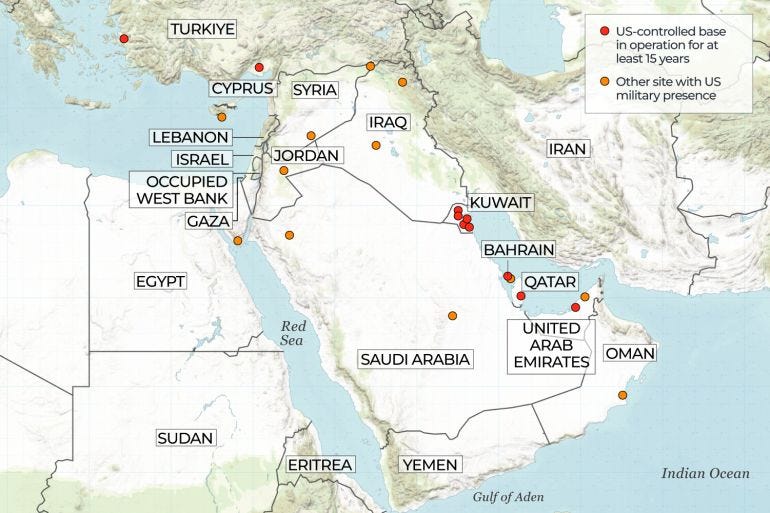
Mapping US troops and military bases in the Middle East (Source: Al Jazeera)
The current distribution of locations, struck by the belligerents, shows that US/Israel strikes primarily targets within Iran, while Iran strikes are on US bases and Israel:
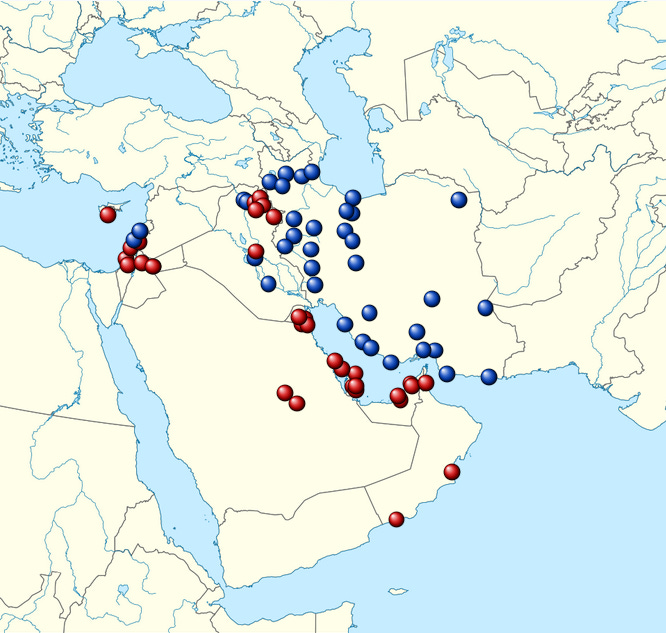
Strikes by US/Israel (blue circles) and by Iran (red circles) Source
Next, what constitutes victory (by either side)? According to the White House, the objective of the operation is “to eliminate the imminent nuclear threat posed by the Iranian regime, destroy its ballistic missile arsenal, degrade its proxy terror networks, and cripple its naval forces” and ultimately “crush Iranian regime” (that is, achieve regime change).
The Iranian objective, apparently, is to prevent the fulfillment of these goals, most importantly, to ensure regime survival. A decisive Iran victory would be destroying or chasing away the US naval forces and destroying or forcing abandonment of the US bases in the vicinity.
As I said in the beginning, I’ve no idea how this conflict will turn out. But, according to the network that I call “the dissident American security experts” (retired military and intelligence officers such as Douglas Macgregor, Daniel Davis, Larry Johnson, and others), the logistics balance doesn’t favor America. I’ve been reading their opinions for years, and generally I find their analysis sound. Their predictions don’t always turn out to be correct, but predicting the future is hard. What’s important is that they explain the factual basis for their opinions. And their judgment is that the US is in a logistically weak position. First, America suffers from depleting stocks of attack and defense ordnance. Second, America has a very long supply chain, stretching over many thousands of kilometers, while Iran is right there, next to (and even within) the theater of military operations.
In yesterday’s blog post, The US Missile Defense Shortage is Worse than Imagined, Larry Johnson did a rough calculation on how long the US supply of Patriot missiles could last. As he explains,
the PAC-3 MSE (Patriot Advanced Capability-3 Missile Segment Enhancement) is effectively the primary missile used in the modern Patriot system for most high-priority threats, particularly in current U.S. Army and allied operations as of 2026.
His calculations suggest that the US PAC-3 MSE missiles will be exhausted on March 23, 2026. This is a strong prediction, and we will soon know whether it is correct, or not.
The big question, of course, is what is the situation on the Iran’s side. Has Iran accumulated enough missiles and drones to outlast America and has it (and can protect) facilities to continue production in the long run?
This is the material aspect of the conflict. Equally important is whether the Iranian leadership has, or will develop enough elite asabiya and popular support to continue fighting until they achieve their military objectives.
The current Iranian regime (or, rather, the one extant on February 27 — things have changed a lot in the past 5 days) has been structurally quite weak due to rampant corruption and lack of popular support. But it survived massive anti-government protests last year. Furthermore, an external attack of the kind it is currently experiencing tends to suppress internal divisions and nurture collective solidarity, both within the elites and between the elites and the people. In the long run, these forces will likely forge high levels of asabiya and lead to a much more functional and internally consolidated regime. This is a general macro-historical pattern, about which I recently wrote here: From Steppe Frontiers to Gunboat Frontiers.
But this “long run” may be really long (e.g., many decades) and along the way a lot can happen. At worst, Iran could be so severely defeated that it will end up being dismembered by losing various territories with non-Persian majorities. such as the Kurds, Azeris, Balochis, and so on. Still, ethnic Persians are roughly 60% of Iran’s population. It is unlikely that the Persian core would be occupied by victors in the worst-case scenario (where will the troops come from?). This means that the selective pressures will continue to operate on this core until a high-asabiya group emerges, takes power, and likely initiates a reconquista. I repeat, judging from historical cases, this could be a very long process, taking many decades.
In light of this observation, the current Israel/US policy, focusing on repeated decapitations of the Iranian leadership doesn’t seem to be particularly smart. It creates a very intense selection regime favoring tough, effective, and internally cohesive elite groups. In the nonlinear world, what works in the short run may have the opposite long-term consequences.
I end this post by reminding readers that what I presented above is not predictions. I simply don’t have the data on which to base them (for example, how many missiles and drones do Iranians have, and how fast do they replenish their stocks?) Instead, this is a framework, based on Cliodynamics, that suggests what are important developments to pay attention to, and how they shape the future course of the conflict.
Professor Turchin, your analysis of the logistics and Asabiya is structurally brilliant. From a geopolitical perspective, I agree with every point.
However, you are assuming that the target of Operation Epic Fury is Tehran when in reality it's Washington.
You view the logistical exhaustion of PAC-3 Patriot missiles as a strategic miscalculation by the US. If we look closer at the procurement shift, it becomes clear that the exhaustion of legacy munitions is in fact a forced product deprecation. It is the forcing function required to pivot the Pentagon entirely onto the attritable, AI-driven drone swarms built by Anduril and controlled with Palantir.
Where Lockheed and Raytheon sold inventory, the new Tech Lords sell software subscriptions like Palantir's Gotham and Anduril's Lattice. A SaaS business model collapses without an active user base. In defense tech, this means you need a manageable forever-war. Total victory and total defeat both lead to customer churn. To maximize shareholder value and justify the recurring revenue of the AI kill-chain, the Lords are financially incentivized to keep the geopolitical temperature perpetually in the Red Zone.
Furthermore, you note that external attacks forge internal Asabiya and suppress internal divisions.
The American Regime knows this. Facing a catastrophic demographic and electoral rejection in the upcoming November 2026 Midterms, the ruling coalition requires a State of Exception to justify the suspension of domestic norms, the deployment of internal security forces, and the activation of the FASAB 56 Black Budget.
I too have followed the "dissident American security experts" during the Ukraine war, when they forecasted an imminent defeat of Ukraine for the last three years.
I found their arguments convincing.
Nevertheless, by now I have to admit that they have been wrong. Not only is Ukraine not defeated, it seems to be moving forward recently.
Given this track record, I will no longer heed the arguments of said dissident American security experts.
I cannot help but be impressed by the USA/Israel alliance's ability to decapitate the regime so quickly and so spectacularly. So far this war has been well planned. If I had to bet, I'd put my money on USA/Israel.