
Multilevel Selection II
MLS in Cultural Macroevolution

In the previous post on this topic, The Controversy over Multilevel Selection, I discussed multilevel selection (MLS) in general, as well as its application to solving the puzzle of Major Evolutionary Transitions. But for my research program the most interesting application of MLS is in Cultural Macroevolution.
Cultural macroevolution (CME) is a subfield of cultural evolution that studies large-scale changes in the cultural traits of whole groups. A central question in CME is how and why characteristics of polities (such as chiefdoms, states, and empires) evolve over time. Over the past couple decades I found that the application of MLS to cultural evolution provides a very useful theoretical framework for understanding the evolution of states and empires over the past 10,000 years.
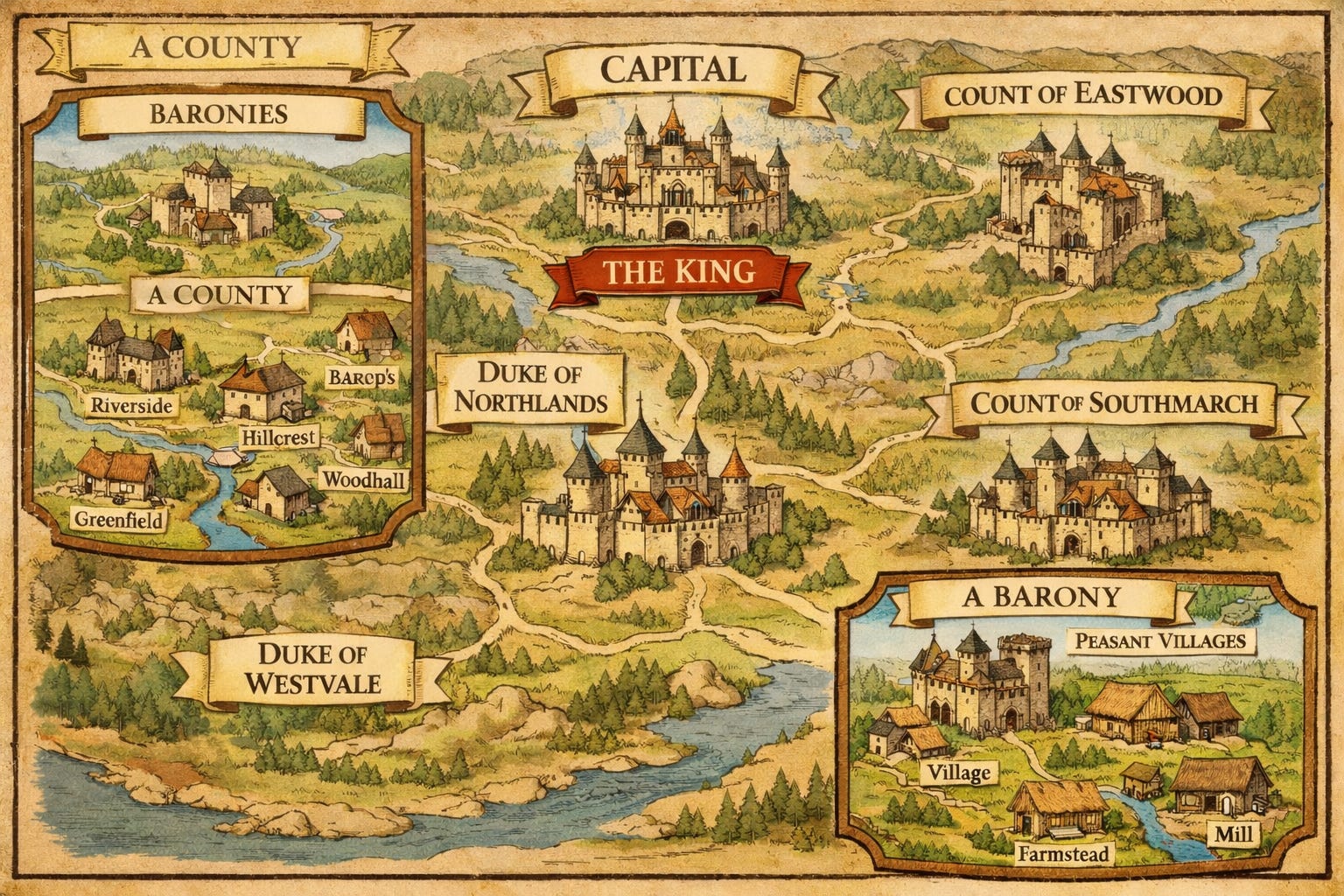
We need a multi-level approach because many polity-level characteristics evolve under selection pressures that act in opposite directions at different levels of hierarchical organization. For example, a provincial ruler and the elite network that provides the basis for his power, may decide that it is in their interest to secede from the overall kingdom. They may dislike taking orders from the king and to be subordinated to the elites in the capital. Even more importantly, they would prefer to keep the taxes, collected in their province, for their own uses rather than share them with the center. When all, or most, dukes decide to secede and form their own independent duchies, the king will not be able to coerce all of them. Such territorial disintegration happened a myriad of times in history.
So, why do we have large states and empires? In fact, the overall trend during the past 10,000 years has been with larger polities replacing small ones. The answer is that large polities, everything else being equal, are stronger than small ones, and they tend to win in the inter-state competition.
The overall direction of evolution, thus, will depend on the balance of centrifugal and centripetal forces. As this balance shifts, in either direction, we see either an integrative trend to larger states, or a disintegrative trend to smaller ones. This is precisely the focus of MLS, and dynamical models based on this theory.
Let’s dig a little deeper into this question. Large empires did not evolve simply as a result of a village growing in population and territory to a huge size. Instead, they are an evolutionary result of repeated combinations integrating smaller-level units (interspersed with periodic disintegrations). Thus, simple chiefdoms united several villages, complex chiefdoms united several simple chiefdoms, and early states united several complex chiefdoms. Territorial organization of large states and empires—hierarchical nesting of territorial units such as provinces, districts, and localities—often reflects this evolutionary history, just as biological organisms retain many traces of their evolutionary history.
A great example of such iterative evolution of social scale is the history of the region that is today France. In the Iron Age, on the eve of the Roman conquest, Gaul was inhabited by a great number of tribes (chiefdoms), most of them belonging to one or other tribal confederation (complex chiefdoms). We know a lot about this political landscape from Julius Caesar, who conquered all of them.
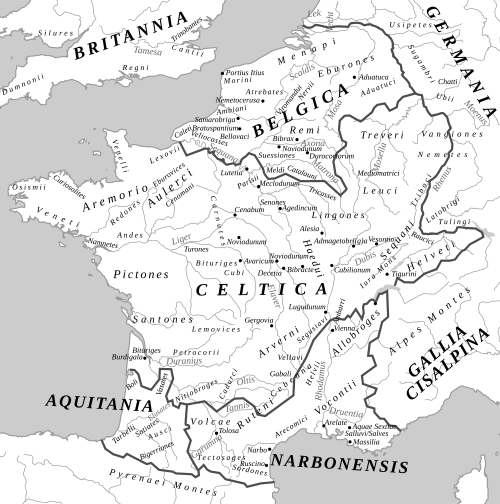
After the conquest, the Roman organization of Gaul simply reflected this tribal organization. Romans divided Gaul into c. 300 pagi (singular pagus, which became the French pays), corresponding to the territories inhabited by individual tribes. The Roman pagus became a county during the Carolingian period and a bailiwick in medieval and early modern France. A Carolingian count (comes) supervised the viscounts (viscomes), just as the later bailiff (bailli) had prévôts as his subordinates.
Under the Romans, the pagi were grouped into civitates, corresponding to the tribal confederations. There were about 60 of them, greatly varying in size. However, they were dominated by 10 larger confederations (the Arverni, the Aedui, the Santones, etc.), which together made up half of Gaul. The Roman civitates roughly correspond to the later provinces/gouvernements. The number of these administrative units varied over time, but on the eve of the revolution, there were 40, including 7 very small ones. This is not a bad match to the 60 Roman civitates since eighteenth-century France occupied roughly two thirds of the Roman Gaul territory. Several modern French provinces still retain the names of the pre-Roman tribal confederations (e.g., the Arverni—Auvergne, the Santones—Saintonge, the Bituriges—Berri). Others (e.g., Brittany, Normandy, and Burgundy) were named after later invaders.
Territorial integration of France, which happened repeatedly between the Iron Age and the early modern age, always occurred in steps, in which smaller-scale units were aggregated into large-scale units, which, in turn, were aggregated into even larger units. In other words, integration proceeded in a hierarchical manner.
Disintegration, similarly, was a multistep process. Thus, when the Carolingian empire collapsed in the ninth century, it was first divided into larger-scale units—France, Germany, and Lotharingia. Next, France disintegrated into duchy-sized units (e.g., Burgundy, Aquitaine, and Provence), which, in turn, fragmented into pagi/counties. In some regions, the process of disintegration went even further, and counties fissioned into castellanies.
The reintegration of France under the Capetian kings was similarly a lengthy and laborious process because the Capetians had to start at the lowest level from their base in Île-de-France, reducing castles one by one and installing in them castellans loyal to the dynasty. Similar processes were occurring elsewhere in France at that time.
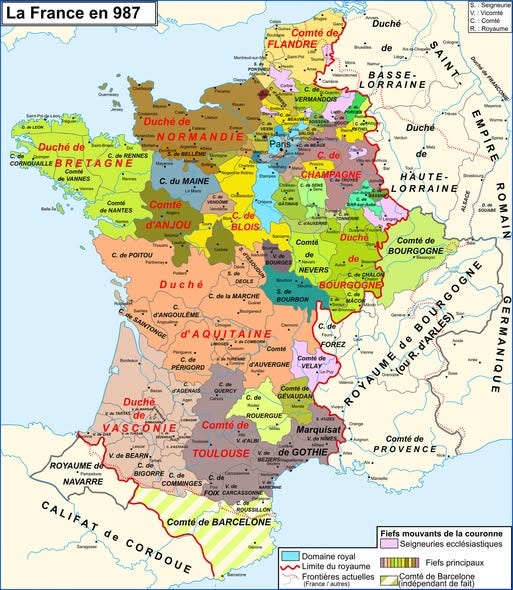
After bringing counties under their control, the counts attempted to expand their power over a duchy. In some cases, they adopted ducal titles (as in the Duchies of Aquitaine and Burgundy), but in other cases they continued to call themselves counts, even though they ruled over duchy-sized territories (as in the counties of Flanders and Champagne). Later on, most of these duchy-sized territories became provinces of the French kingdom.
The French example is a particularly nice illustration of how the process of integration (and dissolution) of large territorial states. But all complex large-scale societies evolved by this general mechanism, and that’s why they are organized in many hierarchical levels. And that’s why MLS is such a productive theoretical framework to study such processes.
If you are interested to further pursue these ideas, take a look at my recent writings: