
The Controversy over Multilevel Selection
Science Proceeds by Paradigm Shifts

One of the longest enduring controversies in evolution is about what was initially called “group selection,” but for reasons I explain below is better referred to as “multilevel selection” (MLS).
Originally, group selection referred to the idea that natural selection can act on groups (as opposed to individuals or genes). It was used to explain how evolution could favor traits that benefit the group even at an individual cost. A particularly important question was to understand the evolution of cooperation. Early formulations (most notably, by V.C. Wynne-Edwards) were quite naïve in that they simply postulated the benefit of cooperation for a group (or even whole species) without considering that it was to the personal advantage of individuals to “free-ride” — to benefit from the fruits of cooperation without paying the cost.
Then, in 1964, W.D. Hamilton came up with the idea of inclusive fitness (also known as kin selection), which seemed to explain better most observed example of cooperation in the animal world, especially social insects. By the 1970s the first notion of “naïve group selection” was thoroughly discredited. An influential popular book in this shift of scientific opinion was Richard Dawkins’ The Selfish Gene. This was a true paradigm shift, which quickly became a new orthodoxy.
But it is usual in science that paradigms replace one another. By the late 20th century, when I became active in this field, the anti-group selection dogma began fraying. Most importantly, the debate shifted to multilevel selection theory (MLS), which recognizes that selection can operate simultaneously at multiple organizational levels (genes, individuals, groups).
Today, in my estimation, the majority of evolutionary scientists view MLS either as a productive, mainstream framework (not fringe, with real explanatory value) or as conceptually valid, but not important, as kin selection does all the work. Only a minority still cling to the anti-group selection paradigm that had become dominant in the 1970s.
MLS is particularly useful in understanding Major Evolutionary Transitions. If you think about it, biological entities, except for the simplest ones, are all multilevel. Eukaryotic cells, such as the ones making up our bodies, evolved by a combination of simpler, bacteria-like cells. Cells are combined in organs, and organs are combined in organisms. Societies consist of many organisms.
Even the idea of gene-centric evolution doesn’t make that much sense, because genes are combined in chromosomes, and chromosomes are combined in genomes. Here’s a slide that I used in my lectures on the evolution of cooperation (when I was still teaching):
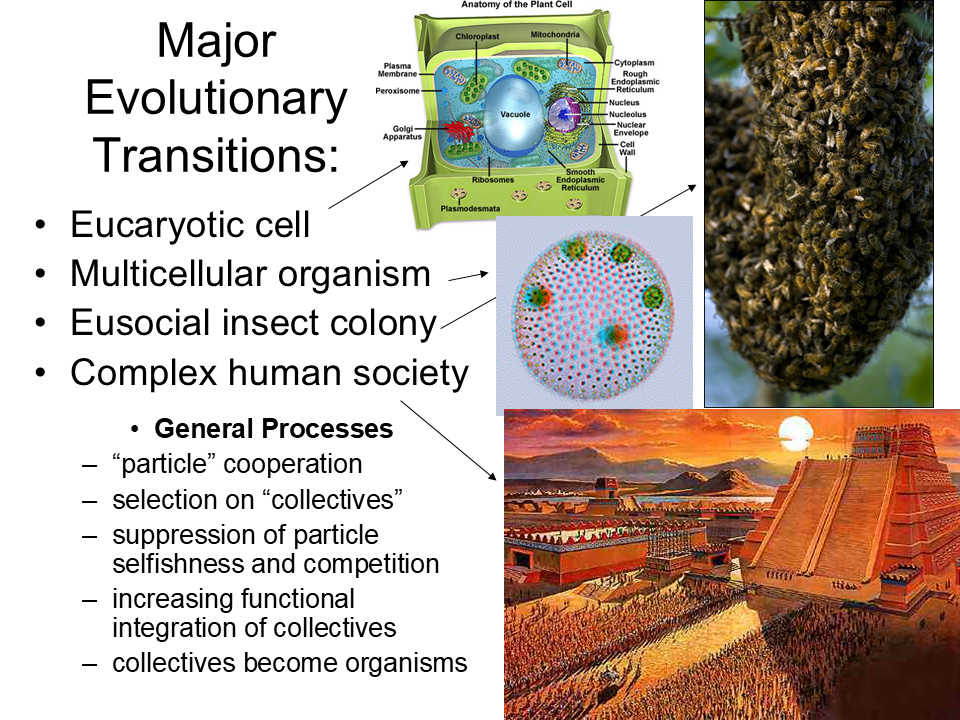
The last major attack on the MLS theory, that I know of, was the 2012 article by Steven Pinker, The False Allure of Group Selection. Since then the debate on multilevel selection has shifted in favor of the proponents of this theory. For example, in 2016 Peter Richerson and colleagues published a programmatic article on the application of MLS to cultural evolution. There was a variety of responses to this article, some favorable (including my own), others less so. But what is curious is that the irreconcilable critics of cultural group selection, Dawkins and Pinker, declined to contribute responses, even though they were invited to do so. A most recent development is an academic volume on MLS (currently in the works) edited by one of the most consistent proponents of this theory, David Sloan Wilson.
I wrote a chapter for this volume, in which I argue that polities — politically independent organizations of humans, ranging in scale and complexity from self-governing Neolithic villages, to chiefdoms, states, and empires — are a legitimate level for evolution to act on.
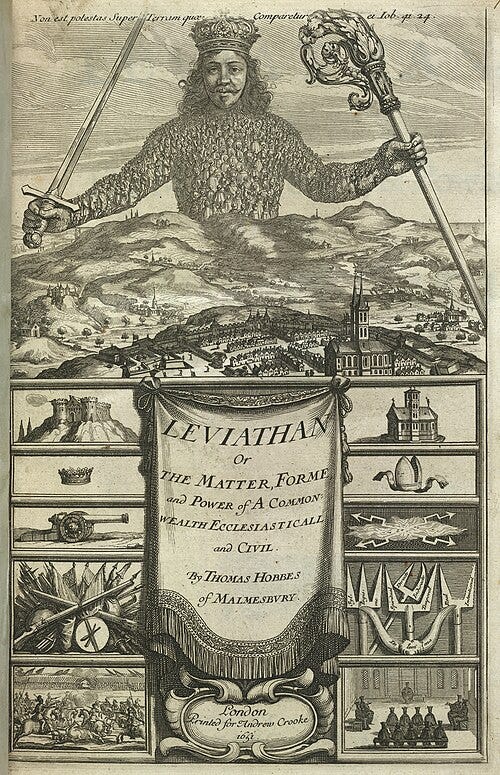
Frontispiece of Leviathan by Thomas Hobbes depicting the state as an organism Source

Indeed, modern states are quite organismal-like — but that’s a good topic for another blog.
What’s important is that we are clearly in another shift of paradigms, and that’s good.
Biology was yet another language used in the 70s for the debate between capitalism and communism over how we are allowed to organize our society. Dawkins offered a language where the 'market' and 'selfishness' are the foundation, while 'solidarity' is a fragile superstructure. And this was the greatest gift to capitalism in its struggle against communist collectivism. At the height of the Cold War, science became part of the intellectual space where two systems clashed — communism and capitalism, collectivism and individualism.
The triumph of the 'selfish gene' theory in the 70s was not merely a scientific event, but a conceptual turn that was surprisingly in tune with the spirit of the times. The idea that competition and individual interest lie at the heart of behavior fit naturally into the logic of capitalism, while simultaneously serving as an intellectual contrast to the communist idea of collective priority.
Thus, the priority of the individual level in biological explanations proved to be more than just a scientific hypothesis; it was an intellectual model that harmonized with the values of the capitalist world and stood in opposition to the collectivist logic of communism.
D. S. Wilson, E. O. Wilson ... must keep your Wilsons apart. Here is mnemonic: "D" stands for "dad" of Katie Wilson, the current Seattle mayor. "E" stands for "entomologist" and hence the famous quip "great idea - wrong species"