
America at 250
A Survey of American History from the Cliodynamic Point of View

Today the United States is celebrating its 250th anniversary. And there is a lot to celebrate. America’s achievements during its (relatively) short history have been truly astounding. It’s not an exaggeration to say that it is the most consequential country on Earth.


250 years is not such a long period of time — there are many other countries with much longer history. But it’s enough of “long term” to use as a polygon for testing Cliodynamic theories.
When I started working on historical dynamics, it was not clear to me whether any mechanisms and patterns we find in history would map on the dynamics of the contemporary states. But subsequent work showed that they do map. Yes, technological evolution has completely transformed human experience and economies. But in the political domain, Cliodynamic insights from past societies translate quite well to our own societies.
American history, it turns out, is not exceptional and illustrates several general principles in Cliodynamics. One of these principles forms the core of the Metaethnic Frontier Theory. You can read about it in my books War and Peace and War and Ultrasociety, where I discuss at length the application of this theory to the rise of the USA. In this post, however, I won’t talk more about it due to length limits, instead shifting to another major Cliodynamic theory, Structural Demographics (SD).
Let’s look at how major SD variables changed during the 250 years of American history. Without denying the huge technological transformation, I’ll show how secular cycle dynamics, which have affected all complex, state-level societies since they evolved 5,000 years ago, continue operating in today’s world, using America as the example.
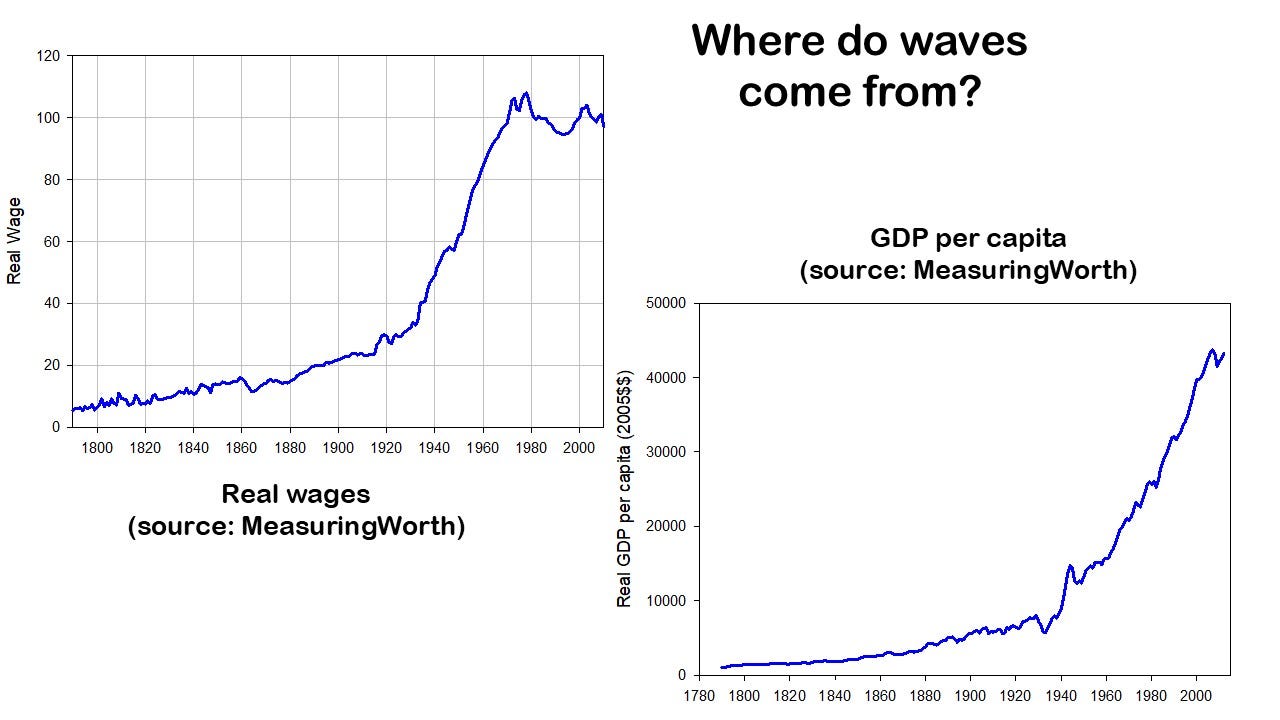
Secular cycles work on top of technological change; these up-and-down oscillations are superimposed on the monotonic knowledge-accumulation trend. Let’s illustrate this idea with economic variables. Below I show two time-series: real (inflation-adjusted) wages and real GDP per capita.
Analysis by the author ©ClioTech (CC-BY). For the data sources, see Ages of Discord.
Both curves show dramatic increases in these variables (with a few minor fluctuations). It is generally agreed that the primary mover behind this growth is technological evolution.
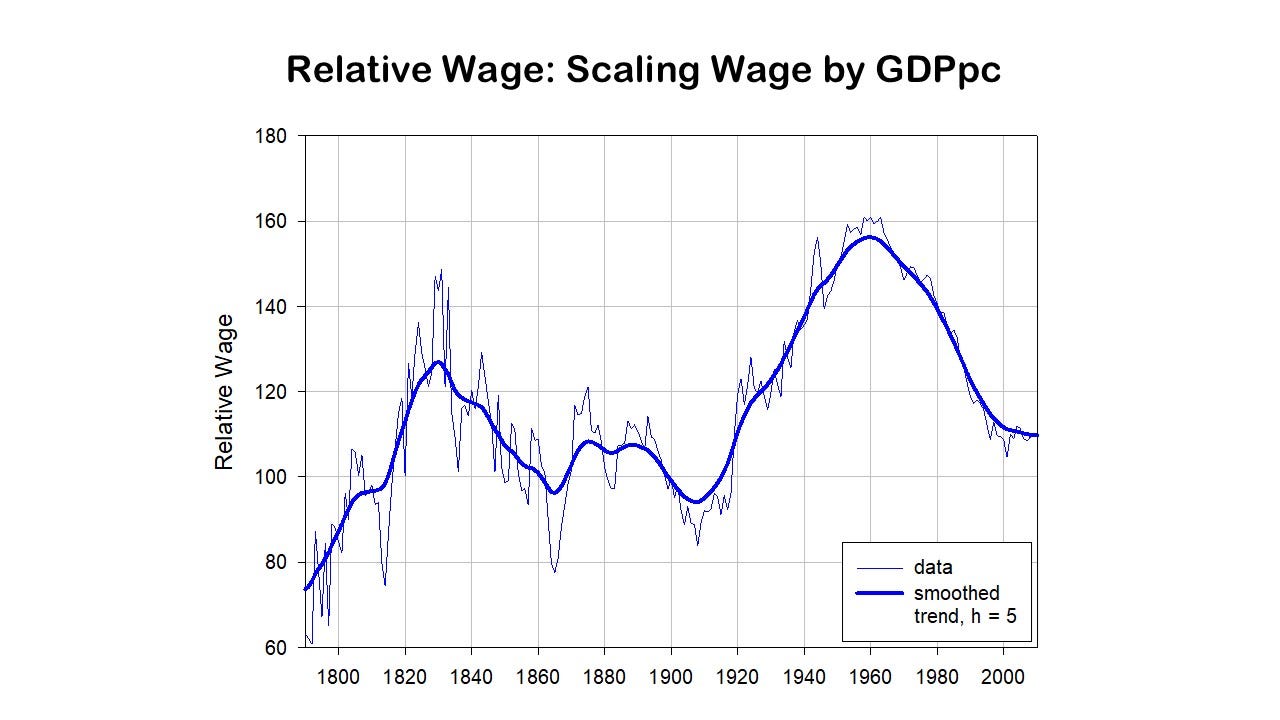
These indicators, however, are not what the SDT cares about. The major engine of change in SDT is the wealth pump, which is quantified by relative wage, calculated by dividing the typical wage of workers by GDP per capita. Let’s do this, and here’s the result:
Analysis by the author ©ClioTech (CC-BY). For the data sources, see Ages of Discord.
Suddenly, secular cycles come into sharp focus. During the period up to 1830 relative wage was increasing, and the wealth pump was working in reverse, with worker wages increasing faster than worker productivity (there is a very close connection between GDP per capita and worker productivity; differences arising only when the number of working hours per year changes, which is a pretty minor effect).
But for the years 1830-1910 the wealth pump was taking away from the common workers and giving to the elites. Another trend reversal in 1910s gave rise to the second secular cycle in America, which has now entered its disintegrative phase.
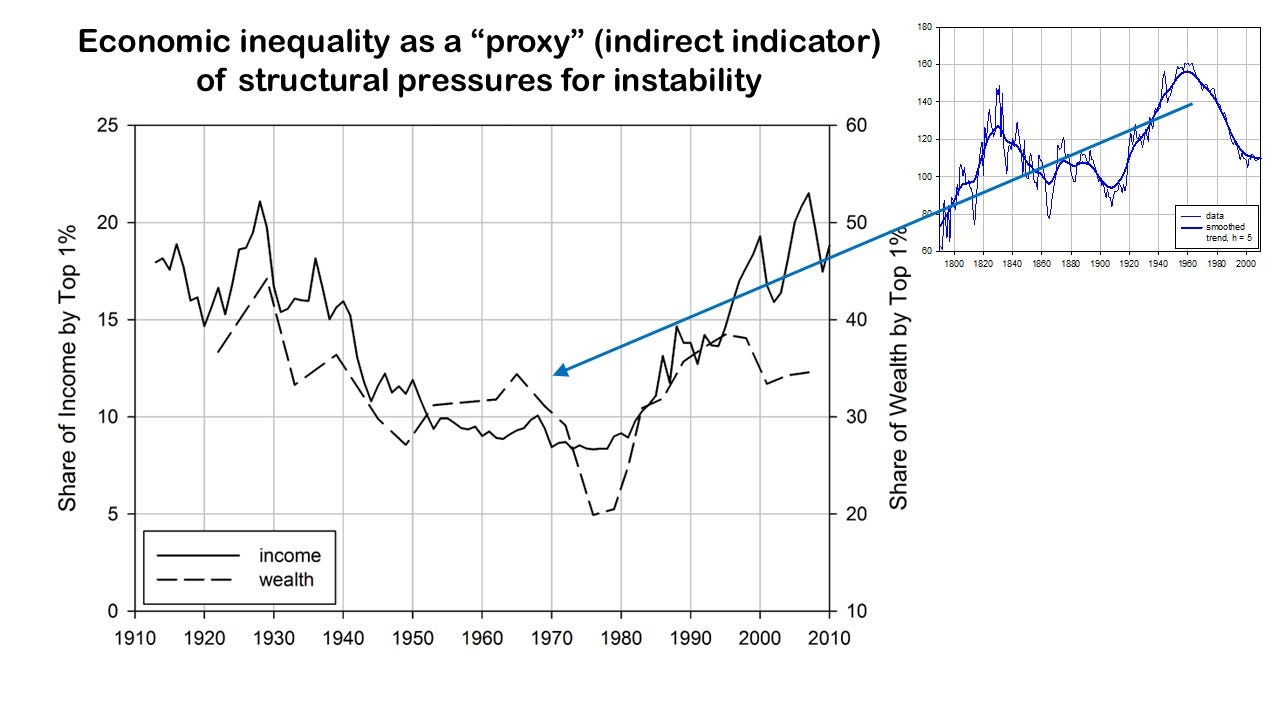
We now hear constantly about how inequality is increasing and how it is undermining stability of the liberal democracies in North America, Europe, and Japan. In the structural-demographic theory (SDT), however, economic inequality is not a primary mover. Instead, it’s a good proxy (indicator) of the underlying SD trends. We have good quantitative data on inequality from the early 20th century on (thanks to the introduction of the federal income tax). Here’s a graph plotting inequality trends for both income and wealth (note that scales are different, they are indicated on the left and right axes).
Analysis by the author ©ClioTech (CC-BY). For the data sources, see Ages of Discord.
The inset in the upper-right corner compares these inequality data to the relative wage. It is clear that there is a strong — antagonistic — correlation between inequality and the wealth pump. When the relative wage grows, inequality declines. The converse is also true. This comparison also illustrates one of the advantages of the relative wages data — it extends further into the past, allowing us to see that our current predicament is not unprecedented — we are now living through the second secular cycle of American history.
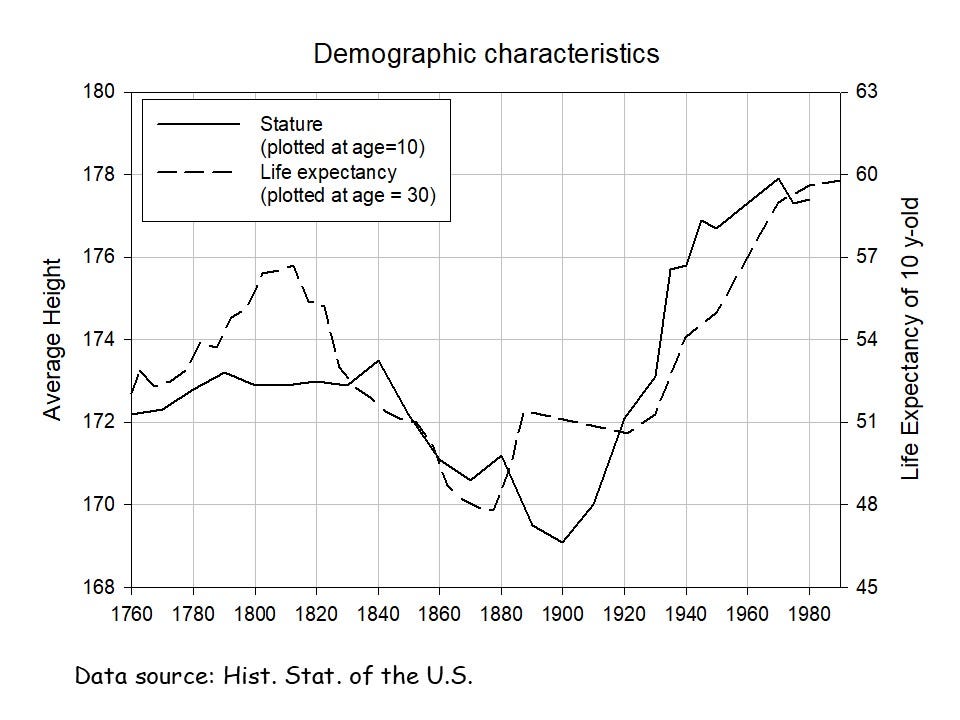
Next, let’s look at biological measures of well-being. Both average height and life expectancy have gone trough secular ups-and-downs, in correlation with relative wages:
Analysis by the author ©ClioTech (CC-BY). For the data sources, see Ages of Discord.
The source for these data is the Historical Statistics of the United States, which unfortunately takes us only into the 1980s. However, more recent data show that both indicators declined in recent decades (details are in Well-being/Immiseration and The Newest Data on Well-Being/Immiseration).
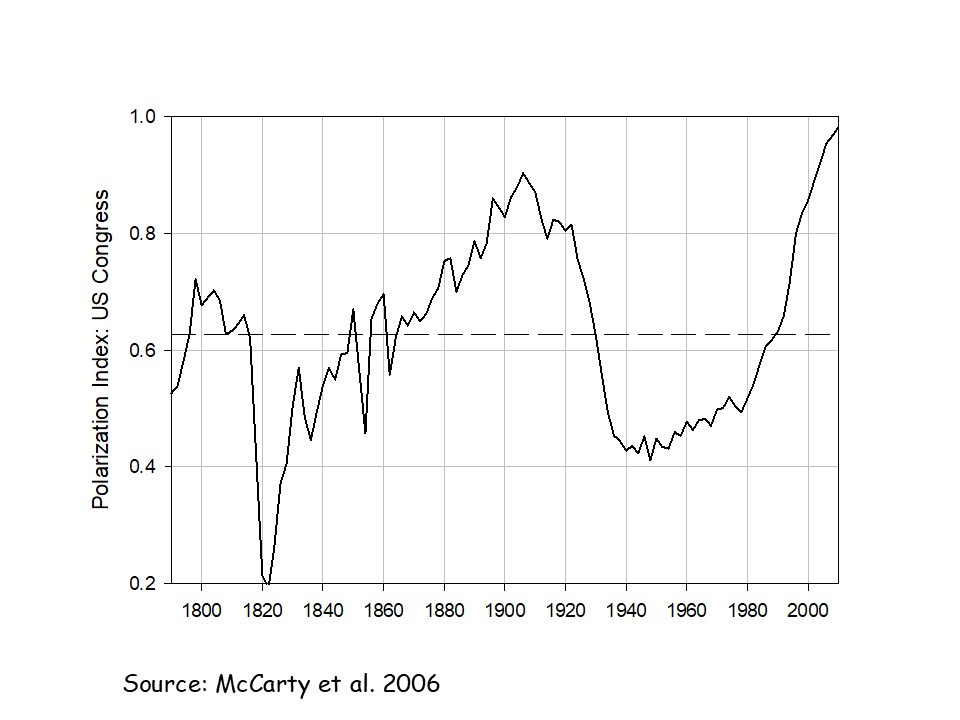
There are many more data series I could show (there are about 50 indicators that I go through in Ages of Discord). But let’s do one more and then a summary. The data below comes from Polarized America by McCarty and co-authors.
Analysis by the author ©ClioTech (CC-BY). For the data sources, see Ages of Discord.
It’s unlikely that you’ve seen the first half of the graph, because the authors focus on the second cycle in their reporting. But they published the data on political polarization in the US Congress all the way to the beginnings of the Republic, which I downloaded and analyzed. Again, we see two secular cycles.
And, of course, the two cycles also show up in the instability data (see Political Violence Trends).
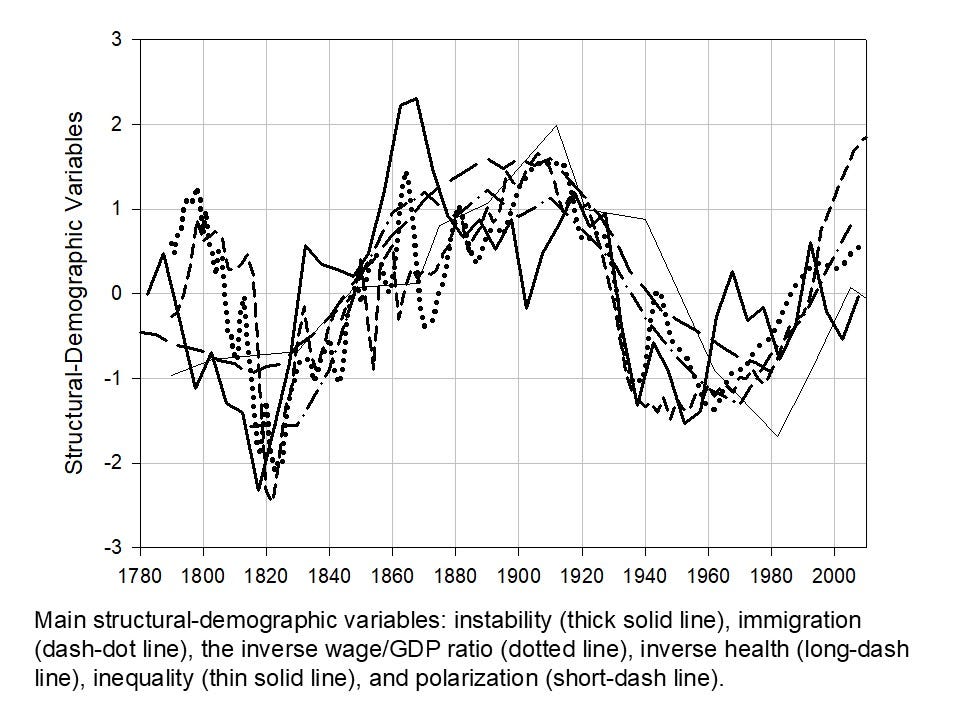
Let’s now put all these (and a few more) trends together on the same graph. Different variables and proxies use wildly different units, but we are interested in the relative changes — ups and downs. We bring these indicators to a common denominator by, first, subtracting their means and, second, dividing them by their standard deviations. This technique makes them fluctuate around the same level (equal to 0) and with a similar amplitude. We also inverse some variables, which act in an antagonistic manner to others. For example, instability is high when relative wage is low, and vice versa, so we multiply relative wage by -1, making it easier to see this (negative) correlation. And here’s the result:
Analysis by the author ©ClioTech (CC-BY). For the data sources, see Ages of Discord.
In this graph up is bad (and down is good). In other words, the vertical axis indicates how bad things are from the SD point of view. Thus, the two troughs, at c.1820 and c.1950, were periods of good times for common Americans and for the polity itself. The decade of 1820, in particular, was known as the “Era of Good Feelings.”
The second half of the 19th century, on the other hand, was a period high SD tensions. Not surprisingly, the American Civil War happened during these times. Today we are leaving through the second secular cycle of social turbulence and political instability (let’s hope that there isn’t going to be another bloody civil war, as it happened 166 years ago).
What I found most remarkable when I first put this graph together is the degree of congruence between different SD variables. It’s not perfect — local fluctuations are often different, and trend reversals in different variables often lag each other by one or two decades. But the overall pattern is clear (and, in retrospect, amazing).
Keep in mind, that the SD theory was developed on data for pre-industrial states. Thus, it is remarkable how well it explains the dynamics of contemporary states. Note also that the data series I show above generally end around 2010. This is because they are taken from Ages of Discord, which I published 10 years ago (these data were also the basis for my 2010 prediction). Recently, I’ve been updating these trends in my series The Structural-Demographic State of America on this Substack.
I’ll end on a personal note. I first came to America in January 1978. This was just 1.5 years after the previous jubilee, the Bicentennial. The 1970s had their difficulties — defeat in the Vietnam War, the Bear Market, stagflation, the oil shocks, etc. But these shocks soon subsided due to the basic resilience of the American social system.
To me, coming from the Soviet Union, it was like living in a fairy tale. America had achieved a level of affluence for common people that was unprecedented in human history. And, particularly important for me, it was an amazing scientific powerhouse.
Today the outlook is much darker. As all SD indicators show, that resilience of 50 years ago is greatly diminished. The social system is extremely fragile, and the likelihood of an outbreak of real violence is high. As often happened in the past, Golden Ages are usually succeeded by Iron Ages.
But such “end times” also carry in them the seeds of new beginnings. This too shall pass. Cliodynamics is not “doom” science. A scientific analysis of history reveals that societies are becoming more resilient to collapse — and shows how to successfully navigate crises (see Why reports that Western civilisation will soon collapse are premature). With a little bit of luck, there will come a third American Golden Age. The next jubilee, 300th anniversary, is likely to be a happy one.
It would be fascinating to see data pre-1776 in America.
Here is how my AI summarized this article. I agree with it.
1. Ambiguous use of “wages” or “relative wages.”
If the reader hears “wages stagnated,” they may infer broad middle-class decline. But the stronger empirical claim is narrower: typical labor compensation underperformed GDP/productivity/top incomes. That is important, but it is not the same thing as ordinary Americans getting poorer.
2. The chart visually compresses several distinct phenomena.
A falling relative wage can reflect worker exploitation, yes. But it can also reflect globalization, rising returns to capital, rising returns to entrepreneurship, changing household structure, China’s labor-market integration, immigration, automation, benefits replacing cash wages, or high-skilled assortative mating. The chart does not sort these mechanisms.
3. “Wealth pump” is a loaded metaphor.
It suggests extraction from workers upward to elites. Sometimes that is accurate: rent-seeking, monopoly, regulatory capture, zoning, credential cartels, political access. But sometimes higher rewards to capital and entrepreneurship reflect genuine value creation under new scarcity conditions. “Wealth pump” blurs productive inequality and extractive inequality.
4. He treats inequality as a stress indicator too quickly.
Inequality can correlate with instability, elite overproduction, and status competition. But rising inequality alone does not prove systemic pathology. You need to know whether the inequality came from value creation, global factor-price shifts, rent extraction, demographic change, or blocked opportunity.
5. His model has a tendency to absorb contrary evidence.
If median household incomes rise, the answer becomes “but relative wages fell.” If relative wages improve, one can shift to elite overproduction, fiscal distress, political fragmentation, or popular immiseration. That does not make the theory wrong, but it can make it hard to falsify in casual essay form.
So I would distinguish Turchin the model-builder from Turchin the polemicist.
The model-builder is asking useful questions about structural stress. The polemicist sometimes seems to choose framings that maximize alarm and narrative coherence, rather than carefully separating:
absolute living standards, relative standing, wage compensation, household income, factor shares, rent extraction, and global welfare.
That separation matters enormously.
A more value-adding version of his argument would say:
The US has become much richer, and median households have become materially better off. But since the late 1970s, gains have been distributed unevenly; returns rose for capital, skill, entrepreneurship, and asset ownership; some regions and workers suffered severe adjustment shocks; elite competition intensified; and institutions failed to maintain legitimacy across the whole system. These are real instability risks, but they are not evidence of broad middle-class immiseration.
That would preserve the good part of Turchin without the loaded part.
My blunt assessment: he is probably directionally right about structural stress, but rhetorically sloppy — or strategically imprecise — about economic welfare. The article would be stronger if it made your distinction explicit: inequality and relative-wage decline are not automatically pathologies. They become problems only when tied to rent-seeking, blocked mobility, deteriorating median welfare, or destructive political coordination.