
The Future Has Arrived
How Ginkgo Bioworks Has Turned Science Fiction into Science Reality

Last week I participated in a meeting of businessmen and investors in Boston. Most of the time, our discussions focused on how various insights from Cliodynamics could help them understand the world we are now living in. But this post is on a different subject.
On Tuesday I joined their tour to a Boston-based company called Ginkgo Bioworks. This was a truly mind-blowing experience and I want to share what I learned with the readers of this Substack.
All photos in this post were taken by the author
The tour started with Jason Kelley, the CEO of the company, explaining the basic philosophy that underlies their business model.
Consider things you do and how they are done, classified within a two dimensional-space. The dimensions are, first, the level of automation — how much personal attention and effort you need to devote to finishing a task. Second, variability or flexibility — how closely what you will accomplish fits what you really want. Typically, there is a negative correlation between the two. The greater the level of automation, the less the fit to what you really need.
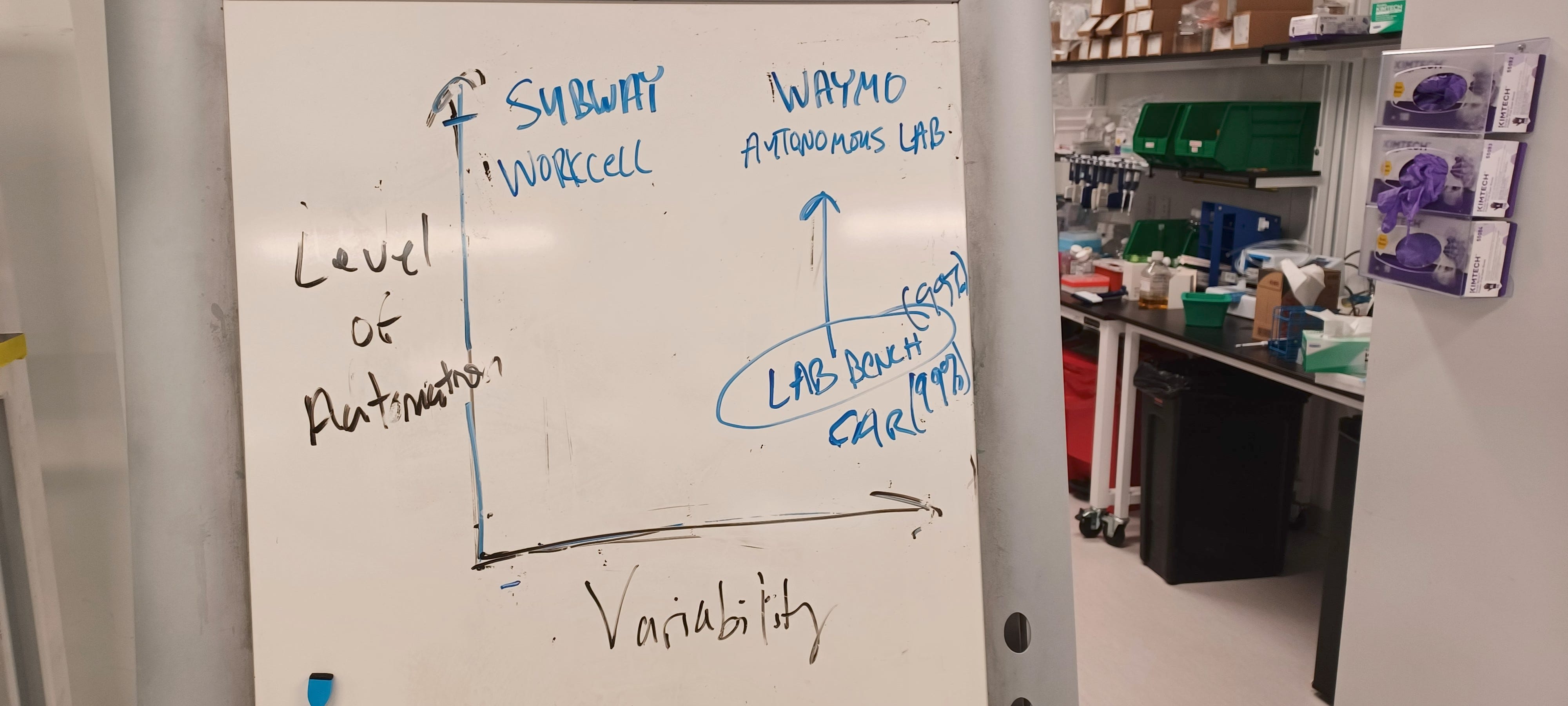
Automation/Variability Space
This idea can be illustrated with the transport system. Subway, and public transportation more generally, is highly automated. You get into a subway car, sit down and read a book (or, more likely today, surf the internet on your smart phone). The subway automatically takes you to your destination without requiring individual control. So it’s high on the automation scale. But there is a limited set of destinations — it’s low on the variability/flexibility scale. If you want to go to a lake away from a subway or bus stop, you are out of luck. You’ll have to drive there using your personal car. Your car, then, is low on automation, but high on flexibility.
But today it is possible to maximize both dimensions: Waymo will do it for you (and soon your own self-driving car).
What Ginkgo Biolabs is accomplishing, according to its CEO, is a similar maximization of both automation and variability, but for the biotech industry. The equivalent of the subway in biotech is the robotic workcell. I looked it up and was surprised to find that industrial robots appeared quite early. The very first date to the 1960s, while their use for biochemical work goes back to the 1980s. But they are limited to performing a single-purpose, fixed, repetitive task. If you wanted to do open-ended scientific research, this would require constant switching to novel tasks, depending on where your current results take you. To do this, until recently, you would have to use human researchers doing manual benchwork.
I’ve been based in biology departments of various universities from 1974, when I started as undergraduate, to 2023, when I retired from teaching at UConn and moved my main place of employment to the Complexity Science Hub in Vienna. During those decades, I’d often walk past molecular biology labs and glance in. What I saw resembled the scenes from Charlie Chaplin’s Modern Times. A group of perhaps 10 graduate students and postdocs in white lab coats squirt some kind of liquid into test tubes with pipettes, then take the tray to one of the 30-40 machines. Next, you need to take it out from that machine and move the tray to another. This looked mind-blastingly boring. And once you became faculty in this field, you needed an army of such industrial (and industrious) peons in your lab to do your science. Ugh. It only strengthened my desire to become (and then be) an ecologist, so that I could do experiments in the field.
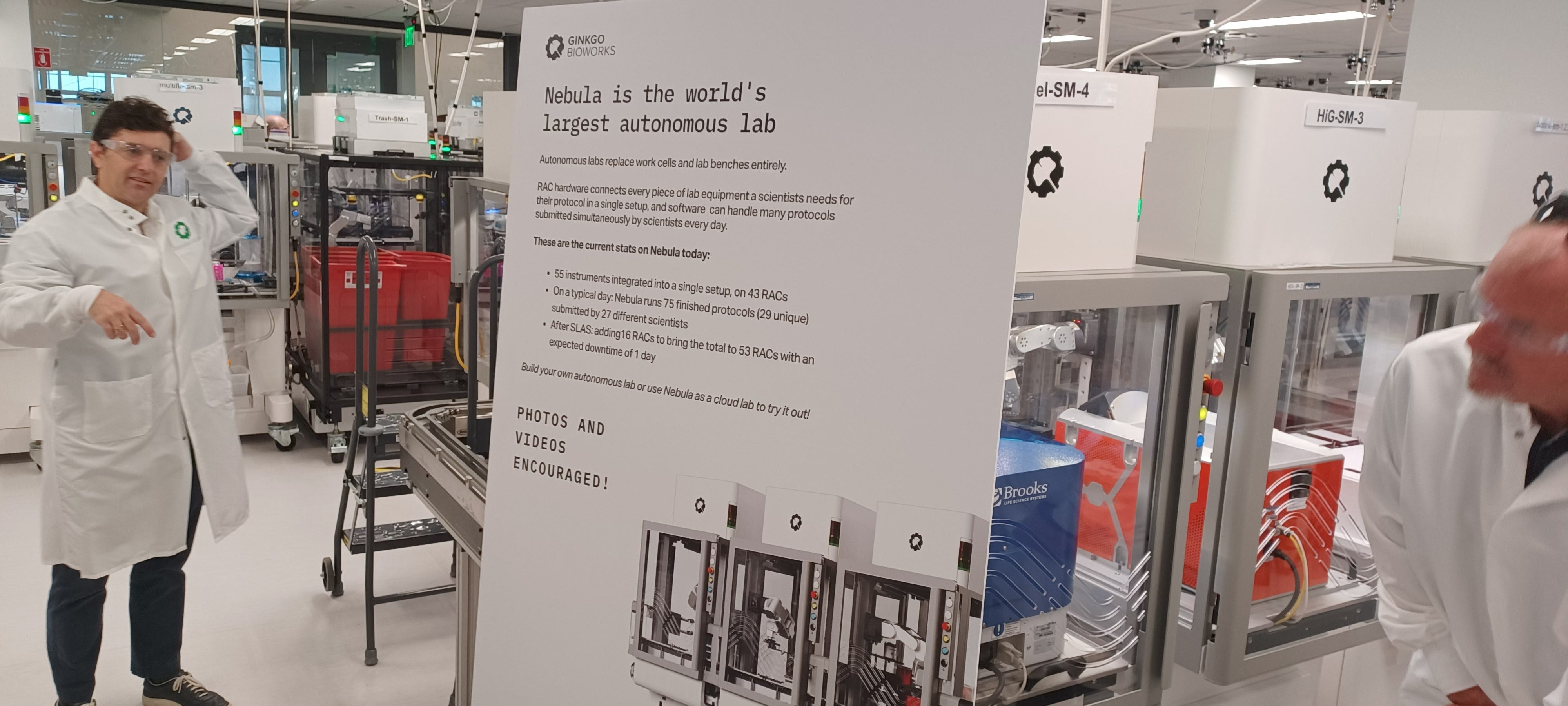
What I saw at Ginkgo Biolabs was the same process, but completely automated. A huge industrial space contains rows of mechanisms for accomplishing various tasks, all connected by rails on which tube trays travel between them (apologies if I don’t use correct language; I am not steeped in the biotech jargon).
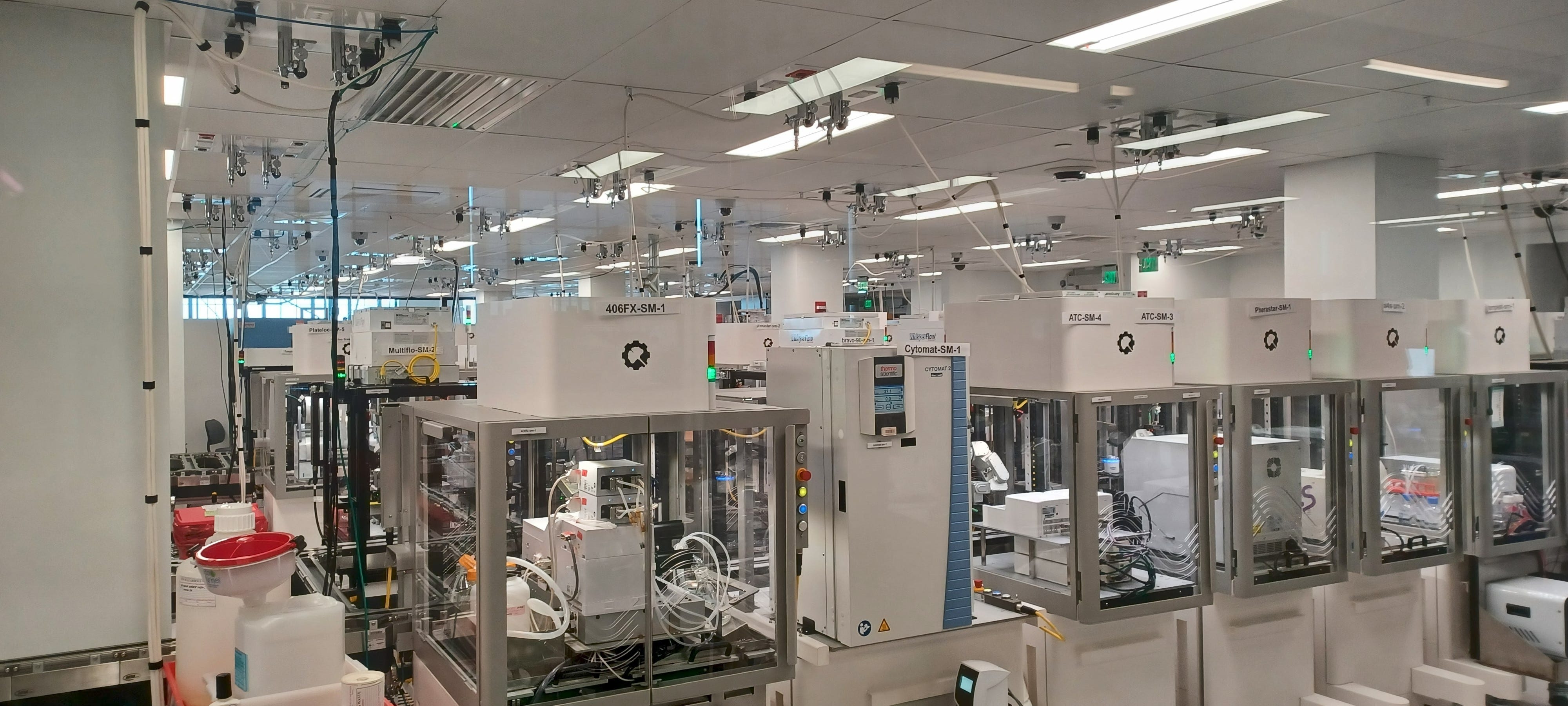
Some gizmos were equipped with robotic arms that manipulated trays of test tubes.
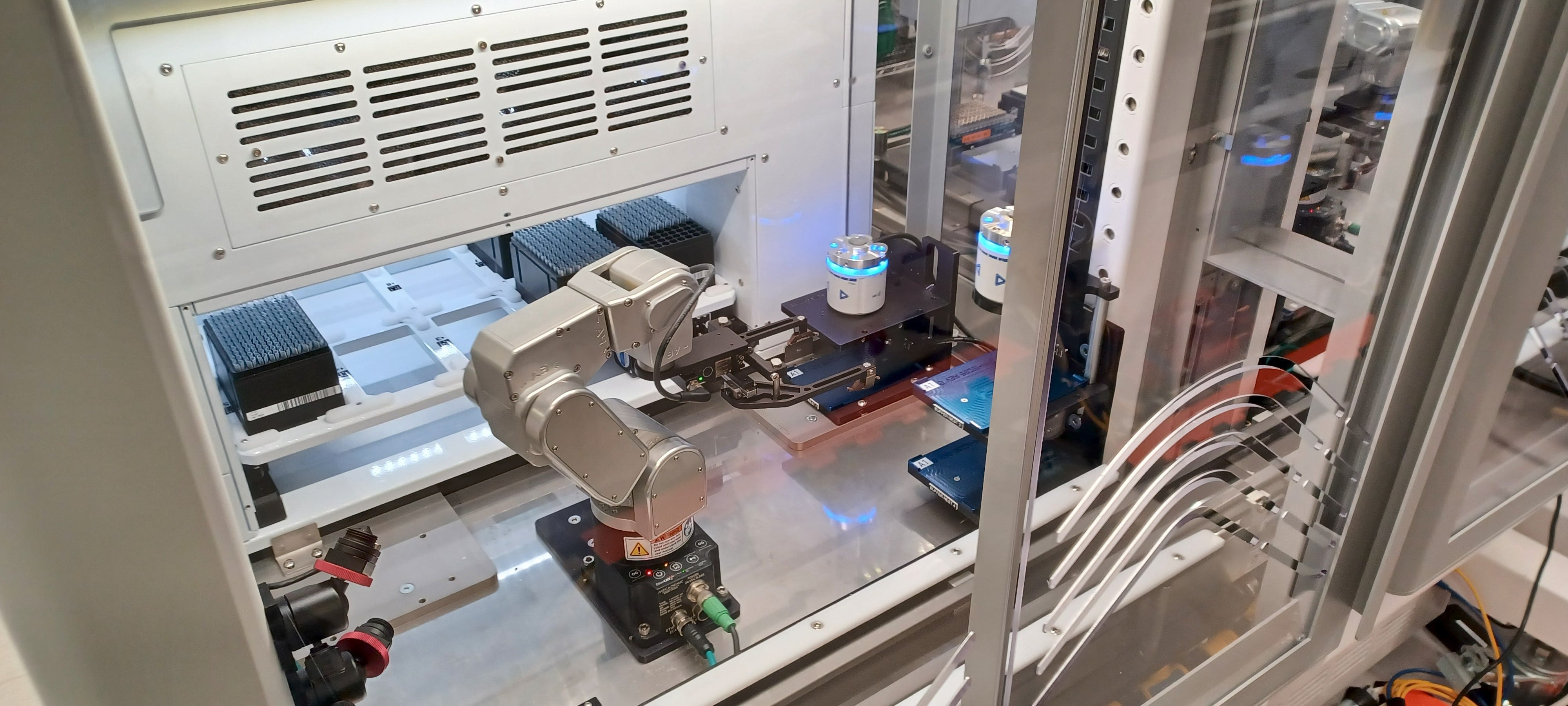
Then, a tray was routed from one apparatus to another using the rails. It looked like a 12-year old’s dream toy railroad, except blown up 1000 times.
I am not good at using the video function on my smartphone, so if you want to get a feeling for it, watch the promotional video on https://www.ginkgo.bio (scroll down to “see ours in action”).
(I probably should issue a usual disclaimer here. I am not in any way connected to Ginkgo Bioworks; I don’t own its stock, they are not paying me to promote them; in fact, they don’t know who I am — just a face in a crowd of 40 people. My enthusiasm is completely a result of being blown away by what they’ve accomplished).
For an avid consumer of science fiction, which I started reading in the 1960s, this was a mind blowing experience — to see how science fiction becomes science reality. But there are also broader implications for the kinds of big questions this Substack deals with.
Think about popular immiseration, the proxies of which we reviewed in a recent post, The Newest Data on Well-Being/Immiseration. The causal factors explaining the decline of relative wage (aka the wealth pump) are complex and subject to much debate among the economists. But the majority agrees that one of the most important reasons is “globalization” — the transfer of skilled, high-paying jobs to overseas regions where labor is cheaper. This is what’s now happening to the biotech industry.
Just a few years ago, according to Jason Kelley, less than 10 percent of biotech work that American companies needed was done in China. Now it’s more than 50%. To make sure I got the numbers right, I asked Google’s AI assistant the same question. It replied that before 2015 5-8 percent of overall biopharmaceutical clinical research and development pipelines were anchored in China. Today approximately 74-79 percent of U.S. biopharmaceutical companies depend on China-based contract research and manufacturing organizations for pre-clinical and clinical services. This is a change on an enormous scale, all happening in just a decade.
Chinese biotech companies employ armies of PhDs performing manual benchwork. In other words, they scaled up enormously the approach in the lower right corner of the Automation/Variability diagram above — the low-automation, high variety/flexibility corner. There is no way that USA can compete with that. Nor should we.
Just as industrial robots saved millions of assembly-line workers from mind-destroying repetitive labor, autonomous biotech labs are in the process of saving tens (or even hundreds) of thousands PhDs from a similar fate. Think about it. After undergoing multi-year rigorous training to get PhD, you are then relegated to being a cog in a giant machine. A shift from manual benchwork to autonomous labs, then, is a win-win development. It increases worker productivity and shifts them from boring to more interesting tasks. Of course, it also destroys the traditional biotech jobs, just as robotization has replaced assembly-line workers. But that’s happening anyway, as those jobs have moved to China.
Jason Kelley recently published an op-ed in Boston Globe, Massachusetts built biotech; China is catching up. The state can’t afford to lose the state’s signature industry. Here’s the key paragraph:
Last week, Representatives John Moolenaar and Debbie Dingell of Michigan introduced the Biotech Investment National Security Act, a bipartisan bill that would add biotechnology to the Comprehensive Outbound Investment National Security Act, known as the COINS Act. The COINS Act is built around a simple idea: American capital and expertise should not be used to build the strategic technologies of foreign adversaries. Semiconductors, artificial intelligence, and quantum computing are already on the list. Biotechnology should be next.
I agree. And not only because I am American and want my country to exit the current crisis as soon as possible, and hopefully without bloodshed. This will require reversing the declining trend in the relative wage (in other words, shutting down the wealth pump). The COINS Act should help with that.
But there is also a second cliodynamic principle that’s relevant here — cultural multilevel selection (CMLS). It’s not a healthy situation when only one country dominates geopolitically, geoeconomically, or geoculturally, whether it’s USA, China, or any other country. It’s not healthy that China, for example, controls nearly 90% of the global rare earth refining and processing capacity. Such monopolization destroys interstate competition, an important aspect of CMLS (this is the main idea in my recent book, The Great Holocene Transformation). And CMLS (hopefully in its non-violent form) is necessary for the cultural evolution of the humanity (and ultimately, in the long run, it will be good for China also).
OK, there is a lot more I can write on this topic but it’s time to bring this already lengthy post to a close (and leave more stuff for future posts).
What began with an interesting, rather rosey discussion of inevitable changes in an industrial base, where tedious tasks become automated, as they invariably do and always have, then turned sharply into a narrow-minded America-rules-the-world bit of China-bashing. Very poor.
I've seen highly automated systems for Elisa assay work in China.