
So, It's China
The focus for the next structural-demographic analysis

Over 600 people voted in the poll asking which country to run the next structural-demographic analysis on. The verdict is clear: China, by far. Forty-two percent chose this country, with the next closest contender, UK, receiving 19 percent of votes. The comments were also overwhelmingly supportive of this choice. There was a lot of good suggestions for other countries, but given limited resources, I’ll have to do it one at a time.
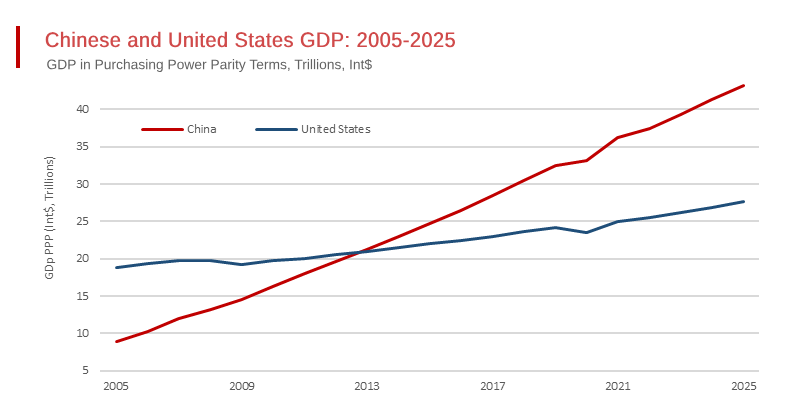
I agree with the general thrust of comments that China is currently the most consequential country in the world. As the American Empire continues to disintegrate from within, the most likely next hegemonic power is going to be China. The size of China’s economy has already exceeded that of the US (measured in PPP terms).
In other forms of social power, military and ideological/soft power, China still lags, but is gaining on America. For example, Chinese movie industry produced quite a number of world blockbusters, starting with the 2000 epic, Crouching Tiger, Hidden Dragon.

I asked ChatGPT and DeepSeek, “If we consider a list of 100 world blockbuster movies in the last decade, what would be the breakdown in terms of countries producing them?” They gave similar answers. USA, of course, dominates, with >80% of world blockbusters, but China is the second, and fastest-growing, contender. ChatGPT estimated its influence as 5-8%, while DeepSeek (predictably) gave a higher estimate of 10-15%. In any case, China has a long way to go yet.
Whether China continues to gain, and eventually overtake America on these dimensions of power will depend a lot on its internal cohesion and stability. Thus, an empirically based and theoretically sound forecast is clearly needed.
On the other hand, it is not yet clear to me whether my team will be able to collect all the necessary data. We will find out.
What are my expectations, based on an informal scan of news about China over the past decade or so? One thing to note is that Main Stream Media is a pretty useless source for gaining accurate information on China. For a good counterweight, I enjoy reading the commentary by Arnaud Bertrand (on X and now on Substack). He is clearly a partisan of China, but I find many of his observations quite relevant.
At the opposite end of spectrum are pundits, like Peter Zeihan. He has been predicting that China would collapse in the next 10 years since 2010 or so; most recently here. As one commentary on this video said, it is “amazing someone can be consistently wrong and this confident.”
Again, based on informal following of the news, my working hypothesis is that China’s stability will be pretty good to 2040 and probably beyond. From the structural-demographic point of view, the major worry for the Chinese ruling class should be serious overproduction of credential-holders and the resulting high unemployment rate for university graduates.
Popular well-being, on the other hand has grown remarkably. Having traveled in China four times between 2004 and 2025, the degree of progress on this indicator is nothing short of amazing.
Economic inequality in China increased dramatically between 1975 and 2010, but stopped growing thereafter. Furthermore, keep in mind that overproduction of wealth holders is destabilizing only in societies in which they can translate their wealth into political power. Rulers of China have been quite careful to prevent such a development, both traditionally and today.
In summary, there are a number of worrying signs, but overall I think that China currently is pretty stable, much more so than the West. I look forward to see whether this preliminary impression is supported, or overturned by a formal data analysis.
And thank you to the paying supporters, who make such research possible!
Hi Peter, I also voted for China, mainly for two reasons. First, its sheer scale and deep entanglement with global systems mean that whatever happens there—whether positive or catastrophic—will ripple across the entire world. Second, and perhaps more interestingly, this seems to be one of the few areas where our views diverge.
In my assessment, China is showing clear signs of a structural-demographic crisis and is likely to go through further major waves of instability before 2050. This might actually be a great opportunity for an SDT study—to test both perspectives empirically and see which one holds up better.
That said, my main issue with working on China is the data: they’re notoriously unreliable. That’s one of the reasons I shifted my focus to Japan. Flawed as Japan’s data may be—messy, patchy, in need of cleaning—they’re still far more trustworthy and transparent than anything out of Beijing. A good example: a few years ago I was working on youth unemployment. The Chinese government briefly admitted the real figure was over 40%. A month later, all the data vanished, and a new “harmonised” set was uploaded, magically lowering the rate to just over 20%. That sort of thing makes longitudinal modelling nearly impossible.
There’s also a bit of a China frenzy at play, pushed by both ends of the political spectrum—liberals touting the myth of the unstoppable socialist techno-state, and hawkish conservatives waving the China threat as a convenient bogeyman. Having spent seven years there, and earned both my MA and PhD from two separate Chinese universities, I’ve come to see that once you focus on net stocks rather than gross flows, a lot of China’s big numbers look far more modest than the headlines suggest.
Anyway, just tossing in my two cents. Could be a great case for testing competing frameworks scientifically! 🍻
I live in Wuhan. Been here 15 years. I look forward to a continued study of China. Americans are utterly misinformed on the subject. That's not to say China is a beatific wonderland; it's to say Americans are spoon fed decontextualized nonsense in large quantities, and the scope and degree of misunderstanding is breathtaking.