

Recently I wrote in this blog about the role that fiscal crisis played in the slide of France into its disintegrative periods of the French Wars of Religion and the Age of Revolution. Watching current news from France I am repeatedly struck by the feeling of “Déjà vu all over again” (©Yogi Berra).
For those of you who don’t follow the news from Old Europe, the French government is (again) broke. France’s fiscal crisis is driven by a high budget deficit (nearly 6% of GDP). The public debt is roughly 115 % of GDP. To make things worse, rating agencies have recently downgraded France’s credit rating, making it more expensive to borrow to make ends meet. Several governments have collapsed. But the president Emmanuel Macron continues to appoint deeply unpopular loyalists as prime ministers.
I don’t know if it’s just me, but I see a number of parallels between France today and on the eve of the Great Revolution. In addition to a deep fiscal crisis, there is political gridlock and inability to push reforms that would resolve this issue. Another one is mass mobilization against the regime in the streets (including barricades!).
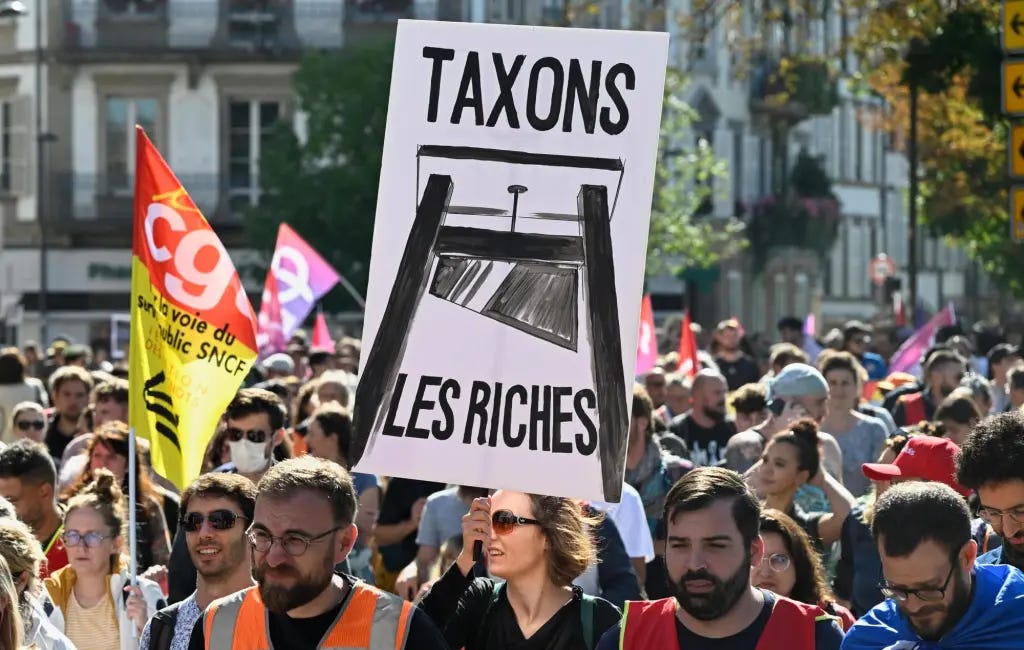
Judging by the image of the guillotine in the above photo, the French themselves are not averse to draw parallels with the Great Revolution.
Will things get that far? Too early to tell. In several respects, the situation today is not as dire as it was in 1788. The main difference is that the data I saw don’t suggest as deep degree of popular immiseration as even in the US (and, of course, nothing like the 18th century when people were literally starving to death).
A cliodynamic colleague has been working on a structural-demographic analysis of contemporary France. Hopefully it will be published soon, but preliminary results suggest that economic well-being for most people has not declined very substantially in the last decades. The pre-tax income shares did, but post-tax shares stayed fairly level. It looks like the state in France has done a decent job protecting the majority. If you can trust these data…
Other structural indicators, however, are in a much worse state. There is a huge overproduction of credentialed youth. Thus, it is not surprising that many demonstrators are students.
The other worrying sign is the huge increase in the number of uber-rich since the 1980. Here’s a graph from the World Inequality Database showing the share of wealth controlled by the top 0.001% (red curve) and 0.01% (blue).
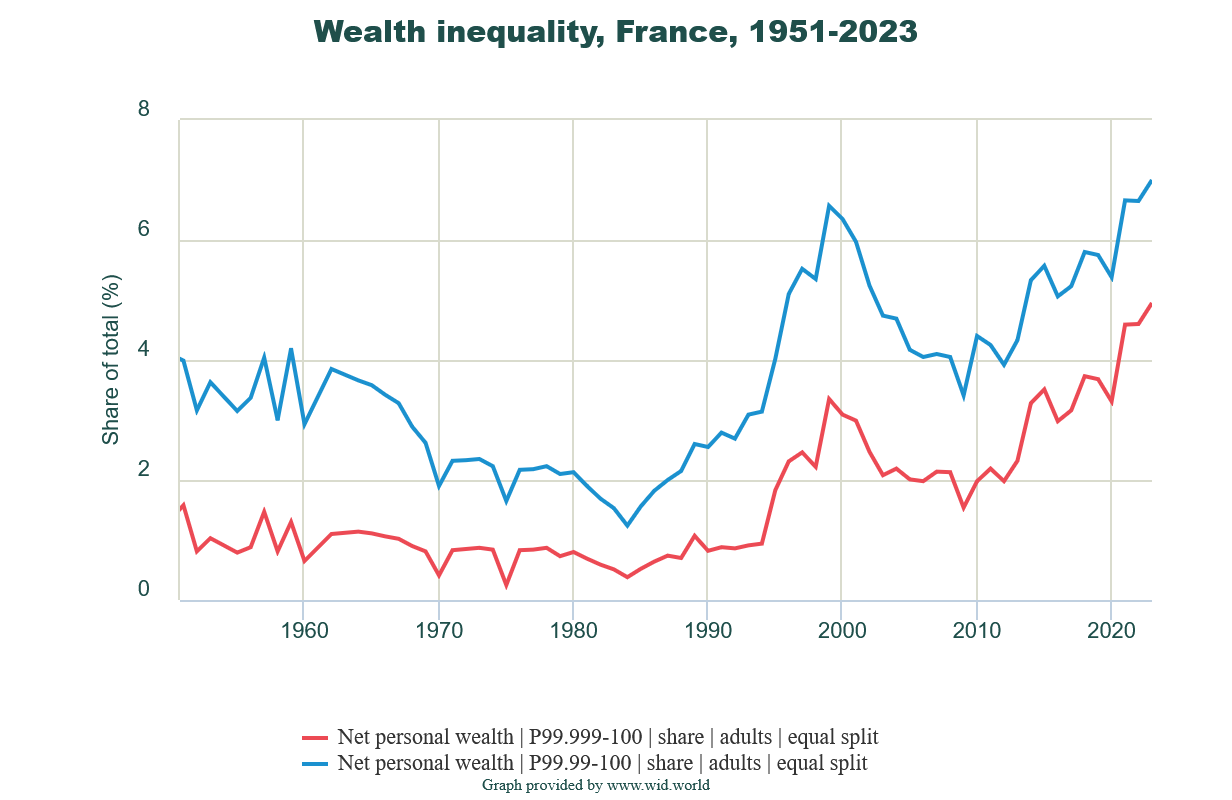
The wealth share of the top wealth class has increased from 0.4% in 1984 to 5% in 2023. To tell the truth, I was surprised to see such a huge effect, as I thought that France had a steeply progressive taxation system.
But the work of such economists as Gabriel Zucman suggests otherwise. The highest tax rates fall on the middle classes, while the extreme rich pay much less.
Zucman is also the author of the eponymous Taxe Zucman (unfortunately, there appears to be no English version of this article), whose intent is to make the French tax system more progressive for the top wealth holders.
Interestingly, 86% of French voters support a 2% wealth tax on France's wealthiest 0.01%. But I wouldn’t hold breath, if I were you. Macron comes from the banking circles and is not about to become a traitor to his class. It might, indeed, take a revolution to solve France’s fiscal crisis, just as it happened last time.
At first, this seems like a simple funding issue. Macron has cut taxes on the wealthy and that needs to be reversed to fund the welfare state, which has, as you point out, kept the population from experiencing immiseration. To compare France today to before the revolution is absurd in terms of standard of living. However, notions of inequality are relative, so people compare themselves to others and the rich instead of the lives of ordinary citizens 50 or 200 years ago, hence the level of outrage.
- 115% debt to GDP is pretty normal, but a 6% deficit does not work well with membership of the eurozone, it needs to go down to 2-4%.
- Given the top 500 fortunes in France increased by almost 10x from 2003 to 2023 and now are equal to roughly 40% of French GDP (source: "La croissance démesurée des 500 plus grandes fortunes"), it is entirely feasible to lower the deficit going forwards by taxing the very wealthy just a bit more.
- A good transcript of a talk on the Zucman tax: "Economist Gabriel Zucman on the benefits of a (modest) billionaire tax"