

I don’t only analyze data on social and cultural evolution, I also just love traveling to see various historical monuments and archaeological locations. As I traveled in Buddhist countries (following the silk route in China, or in Southeast Asia), I visited a number of Buddhist temples. One thing that puzzled me was temple paintings that looked a lot like Christian hell. For example, I saw that in a temple in Dunhuang, but couldn’t take a good picture, so here’s one from Myanmar:
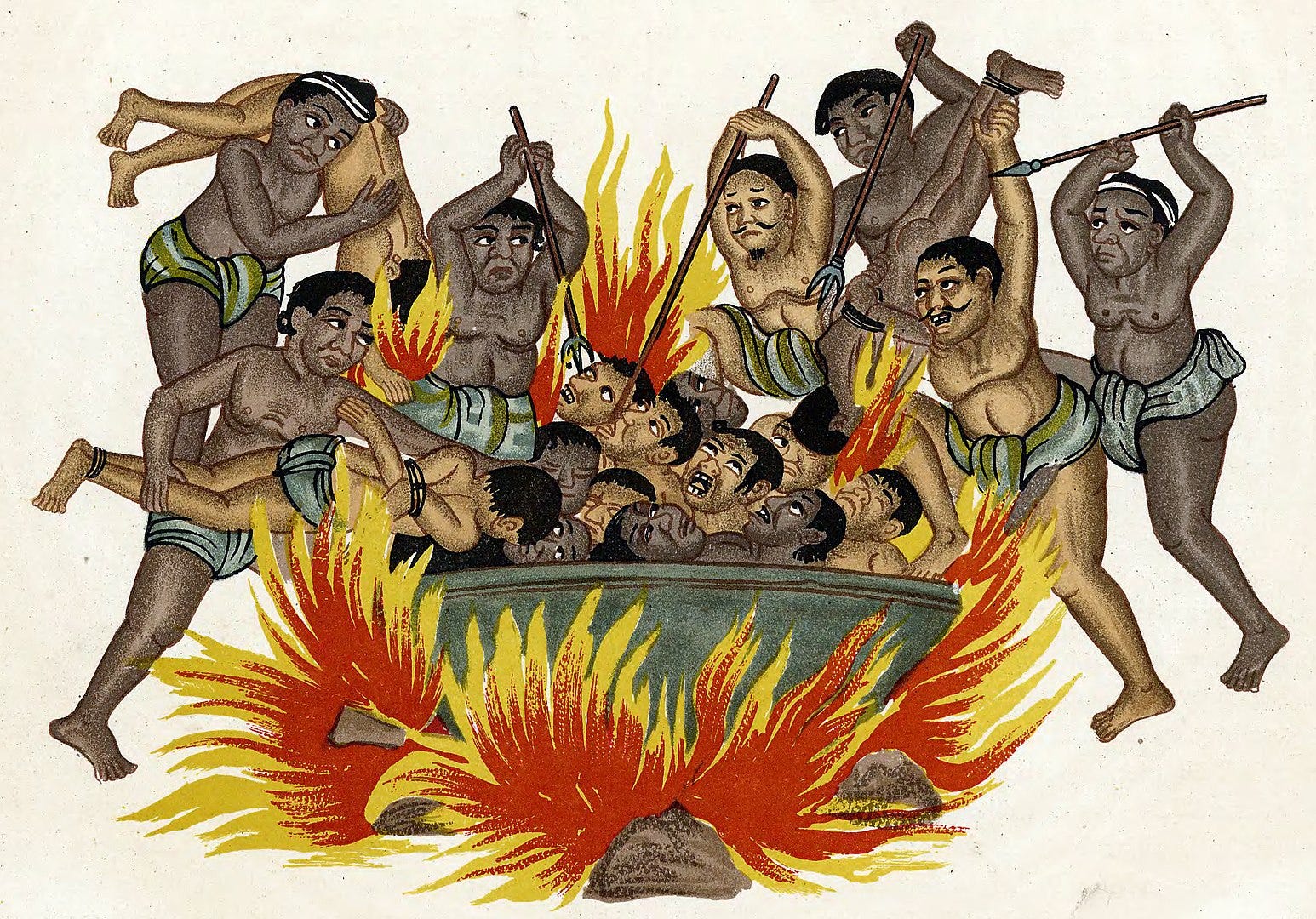
#/media/File:Ngaye_(Naraka)_in_Burmese_art.jpg)
This was puzzling, because at that time I already knew that Buddhism differed from Abrahamic religions (Judaism, Christianity, and Islam) in that it didn’t postulate a supreme deity who punished the sinners and rewarded the virtuous in the afterlife. Instead of an “agentic” supernatural punisher, the central concept in Buddhism is karma, an impersonal supernatural force that governed how people were reincarnated, depending on their actions in life (actually, “supernatural” is even not entirely correct, as Buddhists thought of karma as a kind of law of nature that worked automatically without the need of any intervention).
It was only several years later, as we were putting together our volume on Seshat History of Moralizing Religion, that I learned how the concept of hell fits together with karma in Buddhism. As this book was recently published, you can read about it yourself in Chapter 4 of Part II. But here’s how the author of the chapter on Buddhism, Mark Stanford, explains it:
Central to Buddhist notions of karma is a rich cosmology of heavens, hells, and other realms, populated by a pantheon of supernatural agents (Mahathero 2018). While some karmic effects can be felt in this lifetime, the most salient effects are to be expected in realms inhabited in lifetimes to come (Gombrich 1975). The worst realms are hells, populated by demons, who subject victims to gruesome, protracted torments until they die and are reborn elsewhere. Above the hells are other realms of suffering: rebirth as an animal as punishment for acts of delusion or as a hungry ghost (peta) as punishment for avariciousness. Better than these is rebirth as a human. The best realms are the heavens, where those with excellent merit may be reborn as gods (devas) and live in bliss until they too die and are reborn elsewhere.
In light of this explanation, now I understand who the blue-faced evil-looking characters were, as depicted in this mural from a temple in Northern Thailand:
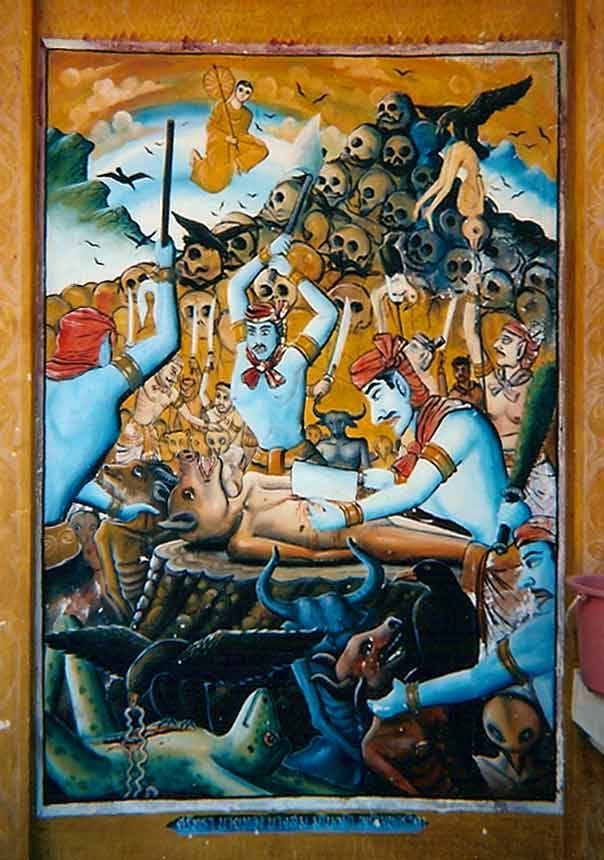
#/media/File:Buddhist-hell-Thailand-2.jpg)
These are hell wardens/karmic demons, whose job is to torture reincarnating people who accumulated really bad karma before they died.
Back in 2023 I wrote in a post Religion is Different:
There were two major flavors of these Axial Age transcendentalisms. The West Asian one emphasized a Big God that monitored human moral behavior and punished the evildoers. The South Asian transcendentalism was based on the notion of karma, a non-agentic force, or universal principle. Despite this difference, these two flavors had a lot in common—beliefs in punishment/reward in the afterlife, internalization of moral norms, and an emphasis on salvation, liberation, or enlightenment.
… the evolution of MSP [PT: moralizing supernatural punishment] is distinct in its mode from other aspects of the Holocene transformation, which, unlike full MSP, arose repeatedly and independently in different parts of the world. Instead, full MSP evolved in a particular world region at a particular time, and then spread from there.
The more I learn about moralizing religion, the more I am inclined to believe that all “World Religions” (fully developed moralizing transcendentalisms) stem from a single root. There are just too many similarities between the Big God and karmic religions to postulate their independent evolution. Even the idea of final judgment is also present in some versions of Buddhism:
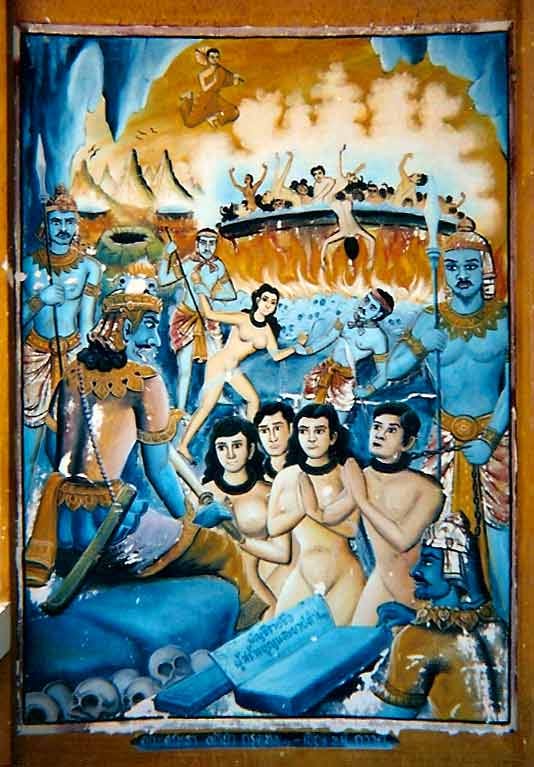
A mural from a temple in northern Thailand. The unclothed spirits of the dead are brought before Yama for judgement. Phra Malaya watches from above as beings are fried in a large oil cauldron. Source.
#/media/File:Buddhist-hell-Thailand-3.jpg)
"There are just too many similarities between the Big God and karmic religions to postulate their independent evolution." Can you elaborate? As far as I can see Christianity and Buddhism are an example of convergent evolution. Their fundamental rationales are wholly different as you note even as their conclusions (missionary, world-renouncing, asceticism, celibacy) are similar. Both value sustaining and spreading their memeplexes above all, the biological vehicles and their reproduction becoming secondary. It would be interesting to have evidence of shared influence between Mideast East and India.
The single root:
"Prosocial religions as folk-technologies of mutual policing"
https://scholar.google.com/citations?view_op=view_citation&hl=en&user=ZHpmcFYAAAAJ&sortby=pubdate&citation_for_view=ZHpmcFYAAAAJ%3ARGFaLdJalmkC&inst=6416714965532506866